Supply chains are one of many market forces in constant motion. They are networks that work in two directions—moving goods from producers to consumers and profits from consumers back to producers. That may sound simple, but these complex chains are tied directly to local, national, and global economies.
Food supply chains are no different and carry the responsibility of feeding all 8+ billion of us. The World Economic Forum, an international non-governmental organization, values the global food market at $9.12 trillion with an annual growth rate of 6.7%.
Unfortunately, the interconnected nature of supply chains makes each part vulnerable to failures throughout. They are often likened to dominoes because of the step-by-step movement of money and goods.
If one domino falls out of place, the entire chain stalls.
Perhaps the clearest recent example was when the mega-container ship “Ever Given” got stuck in Egypt’s Suez Canal—a waterway that experts estimate 12% of all global trade passes through. Shipping data suggests that $9.6 billion of trade was blocked each day the ship was stuck.
Some supply chain failures are temporary inconveniences, but food network disruptions affect our health, wealth, and hunger.
However, we aren’t helpless. There are strategies that nearly everyone can practice to improve their food security and protect themselves from supply chain shortcomings.
Food Supply Chain Basics

According to Harvard University, “A food supply chain or food system refers to the processes that describe how food from a farm ends up on our tables.”
These processes vary but generally include: production, processing, distribution, purchase, consumption, and waste recovery. Harvard further explains, “Every step of the supply chain requires human and/or natural resources.”
Here’s a simplified version of what one looks like:

Not so simple, is it?
Okay, here’s a super simple version:

Farmers are the bedrock of the food supply chain—the producers who make the basic ingredients for all food products. Even heavily processed food contains, in part, plant or animal products that started on a farm.
One crop can change many hands before arriving at your local retail business. Unfortunately, each step in the process increases waste.
The Food Production-to-Landfill Pipeline

Food waste happens at every stage of the supply chain. Most people are aware of food waste and know it’s a problem, but few realize the scale of the issue.
Here are three statistics to put it in perspective:
- The USDA estimates American food waste at between 30-40% of the total supply
- According to the non-profit Feeding America, the U.S. wastes 92 billion pounds of food annually
- The Food and Agriculture Organization (FAO) of the United Nations estimates that one-third of all food produced worldwide is wasted
The good news is that group initiatives—from local to global—are working hard to find, fund, and implement changes to reduce waste.
The Chain’s Weakest Links

Besides waste, food supply chains have vulnerabilities at all levels.
Researchers from the USDA found that even temporary supply disruptions “immediately affect nearly every American household” by reducing food quality, affordability, and availability. They also identified a list of serious risks to our food systems, including:
- Natural disasters
- Labor supply challenges
- Livestock disease outbreaks
- Food contaminations & recalls
- Trade restrictions & political conflicts
- Climate change & other environmental factors
The report concluded that “From the longterm perspective, there is a lack of basic resiliency in [America’s] agricultural system.”
However, the researchers also shared ideas for improvement.
Homegrown Solutions
It’s clear food supply chains are deeply entangled in environmental, political, and logistical issues. So, what can we do?
Removing oneself from the supply chain entirely is nearly impossible short of starting an off-grid, self-sustaining subsistence farm. Still, we all have opportunities to decrease our dependence on globally sourced goods.
The simplest place to start is your local community. You might be a short drive away from a local farm that sells fresh eggs, dairy products, seasonal produce, jarred goods, and meats.
Farm stores and farmer’s markets offer the freshest, most flavorful food since their products undergo minimal travel, storage, and preservation. This short supply chain also means farm-sourced food racks up lower carbon footprints and less waste than grocery chains.
Farmers can also offer better prices than most because your purchase isn’t funding extensive shipping, processing, or marketing costs.
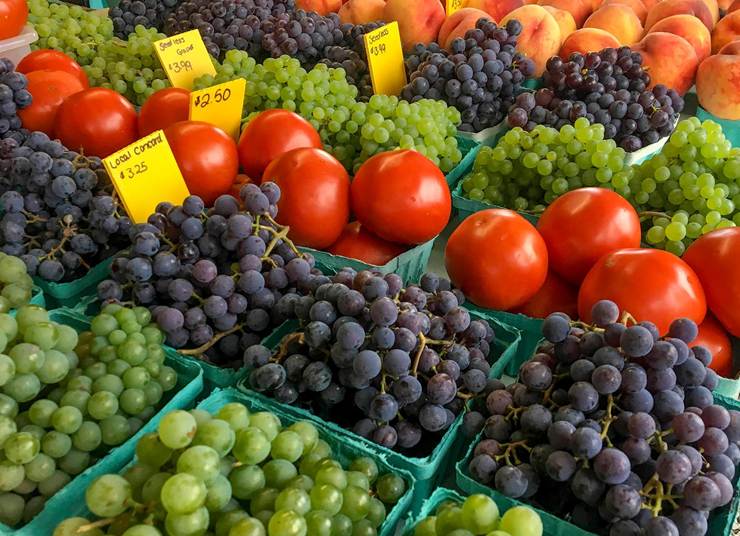
Shopping with local businesses supports a healthier, competitive, and more diverse food market.
You can find another solution in your own backyard. Individuals and families are increasingly exploring subsistence gardening and homesteading lifestyles. These practices build self-sufficiency by swapping store-bought for homegrown goods. Growing your own food feels as good as it tastes!
But you don’t have to jump straight to life-altering changes. In fact, starting small may improve the likelihood of forming long-term habits. Rather than diving into a widespread garden, you can try growing indoor herbs or potted plants.
Small changes like mindful shopping, finding local food sources, or growing produce at home can be big improvements for your health, wallet, and taste buds. Plus, you’ll help support small local businesses while reducing your reliance on global supply chains.
If you live in or visit the Finger Lakes of Upstate NY—The Windmill Market is your premier outlet for farm-fresh produce, small business retailers, and local restaurants. You can also support select merchants on The Windmill’s online store.
You can also find fresh, locally grown food six days a week at Windy Acres Farm—a community ally located just ⅓ mile south of The Windmill.
Thank you for supporting small, local, and family businesses!
Sources
United States Department of Agriculture (USDA), “Agri-Food Supply Chain Assessment: Program and Policy Options for Strengthening Resilience”
Food and Agriculture Organization of the United Nations, “Global food losses and food waste”
Harvard University, “Lesson 4: What is the Food Supply Chain?”
World Economic Forum, “Here’s how we make the $9 trillion global food supply chain sustainable”
Science Direct, “Transport of Fresh Produce”
StudyPlex, “What is a Food Supply Chain? Importance & Management”
Feeding America, “Food Waste in America: How You Can Help Rescue Food”
Recycle Track Systems (RTS), “Food Waste in America”
BBC News, “Suez blockage is holding up $9.6bn of goods a day”
